
Outfits
Give your OC clothes with a purpose
Make jackets, hoodies and accessories support the character story.
· Sonic OC Maker · Revised
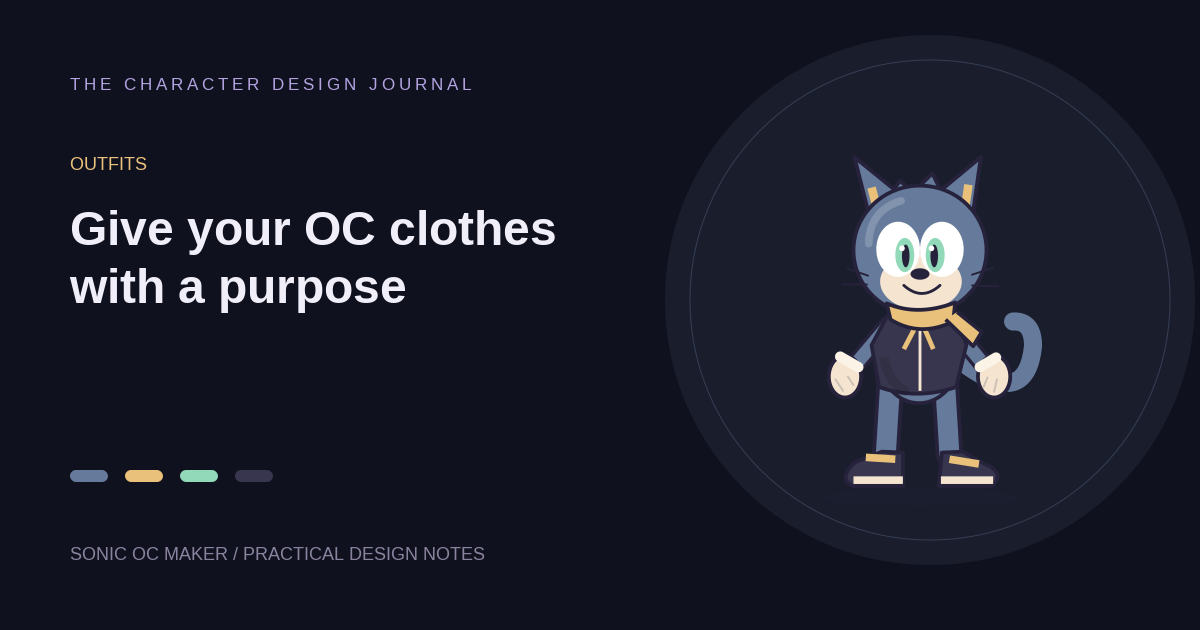
Begin with what the character does while wearing it
Clothing can explain routine: where a character works, what they carry and how they move. Before adding an outfit, write one ordinary activity. A musician waiting outside a venue, a gardener kneeling beside a planter and an archivist moving between shelves create different practical questions.
The studio offers a limited set of clothing parts. Treat them as an initial appearance, not a complete wardrobe generator. If a pocket, protective layer or particular garment matters to the role, record it as a requested addition for later drawing instead of assuming the exported image includes it.
Choose one detail that helps the viewer
An accessory works best when it gives the eye a useful landmark or supports a recurring activity. A scarf may establish a color accent. Goggles may suggest a habit of protecting the eyes, but they do not prove a profession on their own. The story still needs to show what the character does.
Remove the accessory once and inspect the result. If the face and silhouette become clearer, consider whether its role justifies the visual cost. An empty slot is not an unfinished design. Leaving a region simple can make another decision easier to see.
Check how clothing follows the body
When drawing over a base, sketch the body lightly before refining the garment. A sleeve needs a believable opening and a jacket needs room around the torso. Clothing that ignores those volumes can look pasted onto the outline rather than worn by the character.
The same outfit may need different handling around wings, ears or a tail. Decide where an opening belongs and whether it is visible in the reference. The base workflow explains how to keep an untouched version while testing these additions in a drawing application.
Keep color and construction notes separate
In the animal editor, the shoe color also supplies much of the outfit. If you want the final illustration to use a different jacket color, state that clearly beside the exported image. Otherwise, the artist has two conflicting instructions and no reason to prefer one.
A useful note distinguishes a fixed detail from a flexible one: “keep the dark jacket and mint scarf; pocket placement is open.” Add that note to the character sheet. It gives the next person enough guidance to make a decision without making every small feature non-negotiable.